Teguh Anshari Nugraha
Available for freelance work
Hello! I'm Teguh.
Welcome to Codex. A showcase of exceptional design, crafted with precision and creativity.
Here, I document my journey as a UI/UX Designer, working with top-tier clients and driving impactful projects across diverse industries, many of which were delivered under Company. Over the years, I’ve delivered 30+ projects and launched 10+ products across Industry 4.0, government, enterprise, mining, manufacturing, healthcare, and Web3 ecosystems.
Disclaimer: Some projects and products featured here were developed under my previous company and may be subject to NDA restrictions.


Recent projects
2025
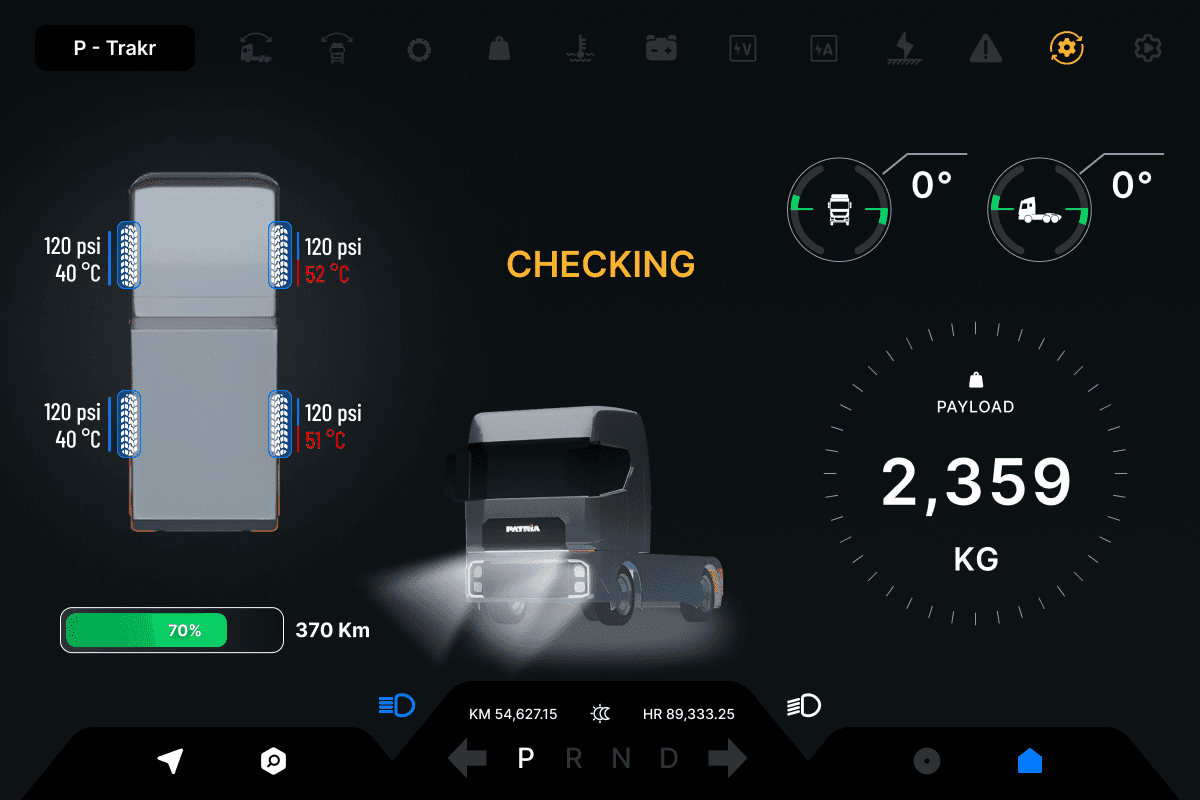
Electric Truck HMI & Vehicle Monitoring System
Overview:
As electric vehicles introduce new ways to monitor vehicle performance and energy consumption, drivers need clear and accessible information to understand their vehicle's condition while on the road. For electric trucks, this extends beyond traditional driving indicators. Drivers also need visibility into payload, vehicle tilt, tire pressure and temperature, battery condition, charging status, and estimated driving range.
To address these needs, we worked on an integrated solution for an electric truck, combining an Android application, tablet interface, in-vehicle Human-Machine Interface (HMI), and a hardware adapter that reads data from sensors installed in the truck. The HMI brings essential driving information and vehicle monitoring into one interface, including speed, payload, tire conditions, battery and motor temperature, charging status, and estimated remaining range. Google Maps API integration also provides navigation within the driving experience.
Impact:
The solution connects vehicle sensor data with digital monitoring and driving interfaces, bringing key vehicle parameters, energy information, and navigation into a more integrated experience.
By combining the Android application, tablet interface, in-vehicle HMI, and sensor data adapter, the project establishes a connected approach to accessing truck information. The interface is designed to make important vehicle conditions easier to review and help drivers understand vehicle status and route guidance in one environment.
Problem Statement:
An electric truck requires more than a conventional dashboard. Drivers need to monitor multiple vehicle parameters, understand battery and charging conditions, and access navigation while maintaining focus on the road.
Bringing sensor data into a digital interface also requires a connection between the truck's physical sensors, the data-reading adapter, and the software used to display the information. Without a well-structured experience, presenting these different data points can become complex and difficult to interpret.
The challenge was to connect vehicle sensor data with a clear digital interface, organizing driving information, vehicle condition monitoring, and navigation into a unified experience across the supported devices.
Outcome:
The project delivered an integrated hardware and software solution for electric truck monitoring. It combined an Android application, tablet interface, in-vehicle HMI, and a sensor data adapter to support the collection and presentation of vehicle information.
The resulting experience brings together driving indicators, vehicle condition monitoring, battery and charging information, estimated range, and Google Maps-powered navigation
Role
Project Lead, UI/UX Designer
Deliverables
UI/UX Design, Product Knowledge
Platform
Android Automotive OS
Android Automotive OS


2025
Employee Attendance & Workforce Self-Service Platform
Overview:
Managing workforce attendance across manufacturing and mining environments can be challenging, particularly in locations where internet connectivity is unreliable. Employees need a dependable way to record their attendance, while also accessing essential HR services without relying entirely on a desktop portal.
To address these needs, we worked on an integrated employee portal and mobile application for Android and iOS. The application supports offline attendance recording, allowing employees to record their attendance even without an internet connection. Once connectivity is restored, the stored records are synchronized with the main server. Beyond attendance, employees can submit leave and overtime requests, monitor request statuses, and access other applications available to them through a centralized application list.
The platform also brings additional employee workflows into the same experience, including NDA verification. The goal was to simplify everyday workforce administration and make essential employee services available through a single, connected platform.
Impact:
The platform brings essential employee services into one connected experience, making attendance recording, leave and overtime requests, request tracking, application access, and NDA verification more accessible.
Offline attendance recording addresses a key challenge for employees working in manufacturing and mining environments where internet connectivity may be unreliable. By allowing attendance records to be captured offline and synchronized when connectivity returns, the application supports a more flexible and dependable attendance workflow
Problem Statement:
Employees working in manufacturing and mining environments may face limited or unreliable internet connectivity, making digital attendance systems difficult to use consistently. Depending entirely on an active connection can interrupt attendance recording and create additional administrative work when records need to be reconciled.
At the same time, common employee tasks such as requesting leave, submitting overtime, checking approval statuses, and accessing authorized applications may be spread across different workflows or require employees to return to a desktop portal.
The challenge was to bring these essential activities into one accessible platform while supporting offline attendance recording and maintaining a consistent experience across web and mobile devices.
Outcome:
The application was successfully launched on both Google Play Store and Apple App Store, making it available to Android and iOS users. Following its launch, the application operated as expected and addressed the key user pain points identified during the project.
By consolidating attendance and essential employee services into a single mobile experience, the solution provides a practical alternative to relying solely on the web portal for everyday workforce activities. Its offline attendance capability also supports employees working in areas with limited internet connectivity.
Role
Project Lead, UI/UX Designer
Deliverables
UI/UX Design, Product Knowledge
Platform
Android, iOS
Android, iOS


2025
Container Loading Optimization System
Overview:
Container loading is a critical part of logistics and manufacturing operations, where every item, box, and container needs to be planned carefully. When this process relies heavily on manual calculations and arrangements, finding the right box sizes, assigning containers to delivery destinations, and maximizing available space can become time-consuming and complex.
The Container Loading Optimization System was designed to simplify this process by helping users plan the entire loading workflow, from item-to-box allocation to box-to-container assignment. Based on registered items and predefined loading rules, the system analyzes the required box sizes, recommends suitable containers, and generates a suggested loading sequence. It also supports different box arrangement patterns to help users make better use of the available container space.
By transforming manual planning into a more structured, system-assisted workflow, the solution aims to help logistics and manufacturing teams prepare loading plans more efficiently, reduce unused container space, and make allocation decisions with greater clarity.
Impact:
The system shifts container planning from a largely manual process toward a more guided and data-driven workflow. By recommending box allocation, suitable containers, loading sequences, and arrangement patterns, it helps users evaluate loading options without having to plan every step from scratch.
The solution is designed to support more efficient use of container capacity, simplify destination-based allocation, and give operational teams a clearer plan before loading begins.
Problem Statement:
Planning container loads involves more than fitting boxes into available space. Users must determine suitable box sizes, calculate how many boxes are needed, select containers that meet delivery requirements, and organize the loading sequence while following destination-based restrictions.
When these decisions are handled manually, the process can require considerable time and repeated calculations. Inefficient arrangements may also leave unused container space, while incorrect container assignments can conflict with delivery rules.
The challenge was to create a system that could simplify these interconnected decisions and provide a practical, rule-based loading plan.
Outcome:
A centralized container planning solution that connects item registration, box allocation, container selection, and loading sequence recommendations into one workflow. Users can review suggested box arrangements and organize shipments according to destination constraints, helping make container loading more structured and easier to plan.
Role
UI/UX Designer
Deliverables
UI/UX Design, Product Knowledge
Platform
Web Dashboard
Web Dashboard


2024
Smart IoT Dashboard for Real-Time Monitoring & Operational Efficiency
Overview:
This project started from a simple but critical need: companies were gathering tons of sensor data but struggling to make sense of it in real time. We built an enterprise-grade IoT dashboard that helps operations teams monitor what’s happening on the ground, from water flow to energy use, and act quickly when something’s off. The goal was clarity, speed, and control, wrapped in a user interface that feels as smart as the data behind it.
Designed to be adaptable, the platform tracks environmental changes, machine health, and production efficiency. We focused on building a flexible layout system, prioritizing real-time alerts and trend analysis, ensuring every visual component serves a purpose. Its modular design allows it to function across industries without requiring users to learn a new system each time.
Impact:
Teams who previously relied on spreadsheets or raw logs can now spot anomalies within seconds, schedule maintenance proactively, and make decisions backed by live insights. The dashboard transformed organizational responses to problems and enhanced future planning
Problem Statement:
Organizations faced challenges in monitoring and analyzing real-time data from multiple sensors, leading to inefficiencies and delayed decision-making.
Outcome:
The platform enabled businesses to monitor key metrics, detect anomalies, and make data-driven decisions, enhancing operational efficiency and reducing risks.
Role
UI/UX Designer
Deliverables
UI/UX Design, Branding, Product Knowledge
Platform
Web Application
Web Application


Concept
Where Ideas Begin
골목 Golmok - Seoul Hidden Alley AR Discovery Game
A gamified AR city-exploration app where users — both tourists and locals — discover hidden Korean alley culture (골목문화): secret pojangmacha stalls, retro shops, street art, and neighborhood stories — unlocked as you physically walk through Seoul (and later, any city).
Urban Treasure Hunt
Vibrant, Gen-Z-coded interface with bold Hangul typography, neon sign aesthetics, and illustrated map elements. The UI feels like a Seoul night market exploded into your phone — energetic, layered, almost comic-book in its visual language. AR overlays feel like magic stamps on real streets.
Gamify Korean Local Culture
Replace the boring tourist guide with a game. Users earn "골목 points," unlock neighborhood badges, contribute local finds, and share discoverable hidden gems on a community map. Global fans of Korea use this to plan their Seoul trips; locals use it to rediscover their own neighborhoods.
What You'll Show
Illustrated live map with AR pin system · Camera AR overlay screen for unlocking spots · Location card reveals (like a collectible) · User badge / progress profile · Neighborhood leaderboard · Community contribution flow (submit a hidden gem).
골목 Golmok - Seoul Hidden Alley AR Discovery Game


About
I’m Teguh - a Product Designer with a strong background in UX/UI and a deep appreciation for system thinking.
I am a UX/UI Designer with 6 years of experience in digital product design, supported by 2+ years in design leadership, 3+ years as a Product Manager, and 3+ years as a Graphic Designer. Starting my journey in visual communication, branding, advertising, and layout design. Gave me a strong eye for detail and clarity. That early foundation now shapes how I design digital products, blending aesthetics, functionality, and user-centered thinking in every interface I craft.
Throughout my career as UX/UI Designer, I’ve delivered 30+ projects and launched 10+ products across Industry 4.0, government, enterprise, mining, manufacturing, healthcare, and Web3 ecosystems. My work spans customizable dashboards, complex workflows, and data-heavy analytical platforms designed for teams who rely on accurate, real-time insights. Whether simplifying operational processes or supporting mission-critical decision-making, my goal is always the same: transform complexity into experiences that feel intuitive, scalable, and impactful.
I thrive at the intersection of design, data, and product strategy, collaborating closely with cross-functional teams while ensuring every design decision aligns with business outcomes. Based in Indonesia, I continue to deepen my work around Industry 4.0 innovation, data storytelling, and building scalable design systems that grow with the products they support.
If you’re interested in working together or just want to connect, feel free to reach out. Let’s build something meaningful together.
Work Experience
Design Lead
Datacakra
May 2022
-
April 2026
Product Manager
Rekmed Indonesia
Jan 2024
-
April 2026
UI/UX Designer
Confiction Labs
May 2022
-
March 2025
UI/UX Designer
Rekmed Indonesia
Feb 2023
-
Dec 2023
UI/UX Designer
Datacakra
Sep 2020
-
Apr 2022
UI Designer
PT Solusi Jaringan Indonesia
Apr 2020
-
Aug 2020
Graphic Designer
ProAd Communication
Feb 2020
-
Apr 2020
UI/UX Designer Intern
PT Payfazz Teknologi Nusantara
Aug 2019
-
Nov 2019
Graphic Designer
ProAd Communication
Feb 2019
-
Apr 2019
Tools & Skills
The tools I work with are essential to my craft. From design programs to project management apps, each one helps me streamline my process and bring well-rounded design solutions.
Figma
Notion
Miro
Responsive Web Design
Mobile Apps Design
Wireframing
Prototyping
Google Workspace
Adobe Photoshop
Adobe Illustrator